
Orangeburg Pipe in Santa Barbara: Why Homes Built 1945–1972 Are at Highest Risk
Orangeburg pipe is a bituminous fiber sewer pipe made from wood pulp and coal-tar pitch, installed from roughly 1945 to 1972. It has a 30–50-year design life and is now past failure age in every Santa Barbara home that has it.
Book a Sewer Scope — $199If you just learned your house may have Orangeburg, you are looking at one of the few residential building materials that has officially aged out of every conceivable service window. The youngest possible installation in Santa Barbara is over fifty years old; the oldest is approaching eighty. The manufacturer's own published design life was thirty to fifty years. This guide walks through what Orangeburg actually is, how it fails, how to identify it on a camera, which Santa Barbara neighborhoods are most likely to have it, and what replacement typically costs locally.
The short version: If your home was built between 1945 and 1972 and has never had its main sewer lateral replaced, plan as if you have Orangeburg until a camera proves otherwise. The pipe is past its design life, it deforms before it leaks, and it costs less to scope than to dig up. A $199 sewer scope is the move.
What Orangeburg actually is
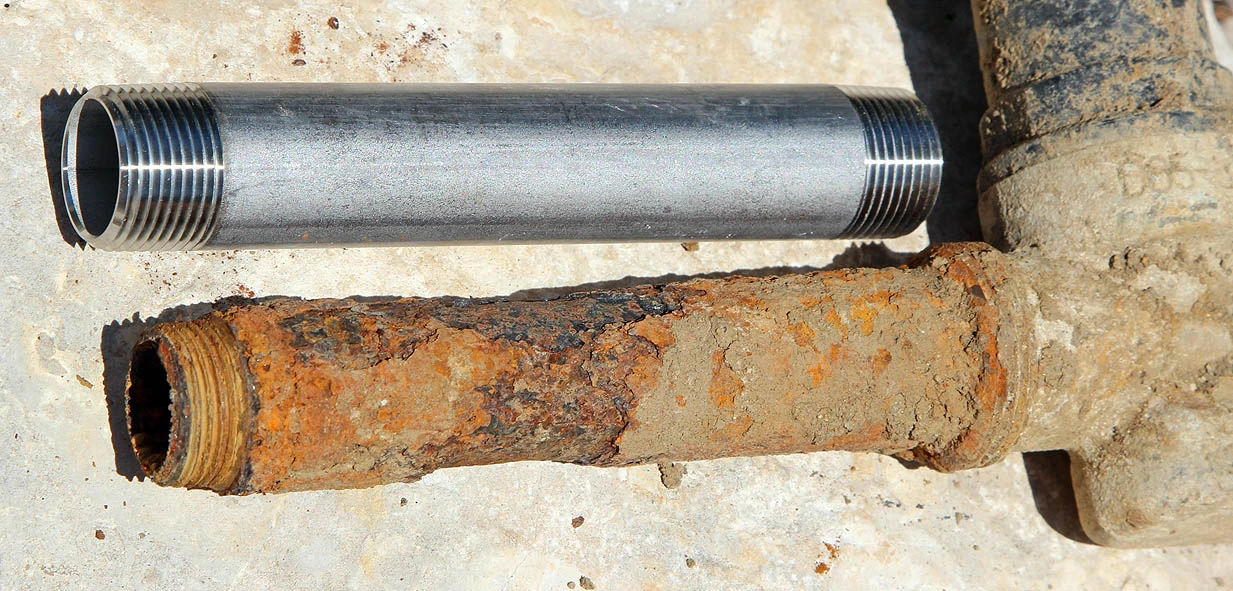
Orangeburg is not a plastic, not a ceramic, and not a metal. It is a bituminous fiber pipe — layers of wood pulp impregnated with coal-tar pitch, rolled under heat and pressure into a tube. The product takes its name from the village of Orangeburg, New York, where the Fiber Conduit Company (later The Orangeburg Manufacturing Company) produced the vast majority of it. For decades the material was used as electrical conduit; its post-war moment came when the same factories converted to sewer-pipe production to feed the housing boom.
The reason Orangeburg exists is supply, not engineering. After World War II, the residential construction boom outran the established sewer-pipe industry — cast iron and vitrified clay. Steel had been allocated to the war effort, foundries were backlogged, and clay was heavy and slow to ship. Orangeburg solved every constraint at once: light enough that two men carried a long section, cut with a hand saw, joined with a tar-paste coupling, shipped by the thousands of feet on rail cars. Builders adopted it nationwide, and Santa Barbara supply houses stocked it through the 1960s.
You will see it called several things on older permit records and in trade conversation. Common names include bituminous fiber sewer pipe, tar paper pipe, no-corrode pipe, and simply fiber conduit. A fresh Orangeburg pipe looks like a dull, matte black tube about four inches in diameter, with a slightly fibrous texture and visible spiral wrap lines on the outside surface. Decades into service, the outside surface stains brown from soil contact, walls thin from the inside as wastewater eats the pitch binder, and the pipe loses its round cross-section under soil load. By the time we see one on camera in 2026, it looks more like rolled cardboard sitting in a creek than the engineering material it was sold as.
How it fails (the five failure modes)
Orangeburg does not fail like clay (which cracks) or cast iron (which scales). It fails the way any laminated fiber product fails when buried in wet soil under load: it deforms, delaminates, blisters, softens, and finally collapses. Here are the five stages your camera will show you, in roughly the order they appear.
1Ovaling and deformation under load
The earliest failure mode and the most diagnostic. Once the coal-tar binder begins to soften under groundwater contact, the pipe wall loses its hoop strength and the weight of the soil column above slowly squashes the pipe from round into an oval. A new Orangeburg pipe is round to within a few percent. By the time we put a camera in one, ovaling of 5 to 25 percent is routine, and severe sections can be nearly flat.
What you'd see on a sewer camera: the picture stops being a circle. Top and bottom flatten, sides bulge outward, and water pools across the bottom of the cross-section rather than running cleanly down the middle.2Delamination — layers separating
Because Orangeburg is rolled paper, not extruded plastic, it is fundamentally a layered material. As the pitch binder fails, those layers peel apart. The outermost layers tend to bond to the surrounding soil and stay put; the inner layers detach and curl inward, narrowing the pipe diameter from the inside and creating snag points for paper, hair, and grease.
What you'd see on a sewer camera: "onion skin" tearing on the pipe wall. Brown fibrous flaps hang into the flow path. The lens often catches on them as the camera head pushes through.3Blistering on the inside surface
As wastewater erodes the pitch binder, pockets of gas and moisture form between the inner layers and bubble outward into the flow path. Some blisters resolve as small bumps; others burst and leave open pits down to bare fiber. Either way, the pipe wall is no longer continuous.
What you'd see on a sewer camera: dark, raised bubbles on the inner wall — sometimes intact, sometimes torn open, often clustered in low spots where water sits longest. The texture is closer to a rotten log than a manufactured pipe.4"Wet cardboard" appearance
Past failure. The pipe has lost its structural identity and now behaves like a soaked paper towel rolled into a sleeve. Wall thickness becomes erratic, sections sag between joints, and roots push through at will because there is no binder left to resist them.
What you'd see on a sewer camera: the wall looks soft, fibrous, and brown-black, with deep root masses growing through it. Pushing the camera further often deforms the pipe in real time as the head goes by.5Complete collapse
The end. Soil load finally overcomes the residual hoop strength and a section pancakes shut. Upstream wastewater backs up into the cleanout, then into the lowest fixture in the house. Once a section is fully collapsed, no trenchless option will work — the pipe must be excavated.
What you'd see on a sewer camera: the camera stops. The lens hits a wall of compressed fiber and soil, or stops in standing water with no visible outflow. The locator wand puts the obstruction at a specific depth, and that's where the trench gets dug.Identification table — Orangeburg vs other sewer materials
The five materials below cover roughly 95 percent of residential sewer laterals in Santa Barbara County. Knowing how each one looks on a camera, and which era it came from, is half the battle in figuring out what you have.
| Material | Era installed | On-camera appearance | Color | Typical failure mode |
|---|---|---|---|---|
| Orangeburg | 1945–1972 | Matte, fibrous wall; oval cross-section; blisters and delamination; "wet cardboard" in late stage | Dull brown-black | Ovaling and collapse |
| Vitrified clay | 1880s–1980s | Smooth glaze; visible bell-and-spigot joints every ~2 ft; sharp cracks; root masses at joints | Red-brown ceramic | Joint separation, root intrusion, cracking |
| Cast iron | 1900–1980 | Scaled, tuberculated interior; reduced bore from buildup; rust-orange flakes; occasional pinholes | Dark gray to rust | Scaling, corrosion, channeling at the bottom |
| ABS plastic | 1975–present | Smooth, matte black interior; solvent-welded couplings; usually clean | Flat black | Solvent-weld failure, UV embrittlement above grade |
| PVC | 1980–present | Smooth, glossy interior; solvent-welded couplings; printed markings visible | White or ivory | Joint separation, mechanical damage during landscaping |
A few diagnostic shortcuts. Matte and dark with no glaze is Orangeburg or cast iron — and cast iron is unmistakable because of the orange-rust tuberculated scale. A smooth red-brown glaze with regular bell joints every couple of feet is clay. Bright white or black with printed markings and solvent-welded fittings is plastic, post-1975. The only material that looks like fibrous rolled paper on a camera is Orangeburg. There is no twin.
Which Santa Barbara neighborhoods are highest-risk
Orangeburg installation tracks construction era almost perfectly. The neighborhoods below are the post-war infill and tract subdivisions where Santa Barbara County housing stock grew the fastest between 1946 and 1972 — which is also the window when local plumbing supply houses were stocking Orangeburg. None of this is a guarantee; the only thing that confirms or rules out Orangeburg is a camera in your lateral. But these are the addresses where we find it most often.
The Mesa High Risk
The post-war infill build-out of the Mesa — particularly the blocks south of Cliff Drive and the streets running off Las Positas — produced thousands of single-story ranch and split-level homes from 1947 through the mid-1960s. Many of these laterals are original, and a meaningful percentage are Orangeburg. Add the saturated soils that come with proximity to coastal bluff drainage and you have textbook conditions for fast deformation.
Lower Riviera High Risk
The streets stepping down from Alameda Padre Serra toward downtown saw heavy 1950s and early 1960s infill on lots that had been subdivided decades earlier but never built on. Laterals on these properties often run long downhill stretches to the city main, and the original Orangeburg, where it still exists, is now compounded by tree roots from mature street trees that were sapling-sized when the pipes were installed.
Westside High Risk
The Westside grew through the 1950s as workforce housing between downtown and the Mesa. Tract-built two- and three-bedroom homes from this era used Orangeburg routinely because it was cheap, fast to lay, and locally available. We see a high concentration of failures here, often discovered during escrow on resales of original-owner properties.
Eastside High Risk
The blocks east of Milpas Street and along the Salinas Street corridor were built out steadily from the late 1940s through the mid-1960s. Many laterals here are original, and the older sections of the city's main sewer system still connect to original Orangeburg services. As with the Westside, Eastside failures often show up at first resale of a long-held family home.
Goleta — Old Town & Magnolia High Risk
Goleta's Old Town and the Magnolia tract were built out aggressively in the 1950s as agricultural land converted to housing. The original tract plumbing across long flat parcels frequently used Orangeburg for the lateral runs to the city main. The flat-grade lateral runs are particularly vulnerable to ovaling because there is little flow velocity to keep the pipe scoured.
Older Lompoc tract Medium Risk
The original Lompoc build-out west of H Street and the Vandenberg-adjacent housing built in the 1950s and 1960s contain a meaningful population of Orangeburg laterals. Concentration is lower than central Santa Barbara, but far from zero on pre-1972 homes.
A note on the vintage-home cluster: Homes that have Orangeburg sewer almost always have other vintage-era systems still in place — galvanized supply lines, undersized 60–100A panels, and frequently Zinsco or Federal Pacific service panels. The same crew of 1945–1972 builders used the same off-the-shelf parts list across the trades. Worth knowing before you scope.
Homes built after 1972 are dramatically less likely to have Orangeburg, and post-1980 homes effectively never do — ABS and PVC had taken over by then. If your home was built outside the neighborhoods above but still falls in the 1945–1972 window, you remain in the risk pool; the list above is concentration, not exclusivity.
Can Orangeburg be repaired, or must it be replaced?
This is the question every homeowner asks the moment they see the camera footage. The honest answer is conditional: it depends entirely on how much deformation the lateral has accumulated and whether the failure modes are continuous along the whole run or concentrated in a few sections. The table below maps what we see on camera to the repair option that typically works and a realistic Santa Barbara price range.
| Condition on camera | Repair option | Likely cost range |
|---|---|---|
| Mild ovaling, <5% — pipe still essentially round; minor delamination only | Spot lining of damaged section, leave the rest in place; re-scope in 12 months | $3,000–$5,000 |
| Moderate ovaling, 5–10% — pipe out of round but liner can still seat | Full-length CIPP (cured-in-place) lining — sometimes works, sometimes blocked by ovaling | $8,000–$15,000 |
| Severe ovaling, >10%, or active delamination | Full replacement — either open-trench excavation or pipe-burst replacement with HDPE | $10,000–$25,000 |
| Fully collapsed section — no further camera travel possible | Open-trench excavation only; no trenchless option works through a collapse | $15,000–$30,000 |
The critical thing to understand about trenchless lining and Orangeburg is that it does not always work. CIPP requires a host pipe still circular enough to support the liner against its inner wall during inflation and cure. Once Orangeburg deforms past about 10 percent ovaling, the liner cannot achieve a round shape and the cured product is structurally compromised before the homeowner ever uses it. A reputable contractor will pre-clean the pipe, scope it after cleaning, and tell you honestly whether the deformation will accept a liner. If they refuse the pre-cleaning scope, get a second opinion.
Pipe-bursting is the trenchless option that does work on Orangeburg in most cases. The process pulls a bursting head and new HDPE pipe through the existing lateral, shattering the old fiber outward into the surrounding soil. The result is a continuous plastic pipe in the same trench line without excavation, except for the entry pit at the cleanout and the exit pit at the city main. Pipe-bursting typically runs in the same $15,000 to $25,000 band as full excavation, but spares hardscape and mature landscaping.
Why a CPI plus journeyman plumber sees what others miss
Identification is a trade question, not a checklist question.
The reason Orangeburg gets missed on home inspections is that most inspectors have never personally pulled a section out of a trench, never watched one collapse under a camera, and have no first-hand reference for what early ovaling looks like versus mature delamination. They see a dark, round-ish pipe on the screen, mark "appears serviceable," and move on.
Coastal Shield is structured to avoid that gap. The inspector on every job is Louis O'Connor, a Certified Master Inspector who came up through the plumbing trade. The on-camera identification calls we make are based on having held the material, dug it out, and replaced it — not on a training-course slide. When we tell you the wall texture is consistent with Orangeburg, that is a trade call. When we tell you a CIPP contractor's estimate is unrealistic for the deformation we just saw, that is from the same trade background. Identification is the whole game on this material, and identification is where journeyman experience earns its keep.
Common questions
Orangeburg pipe, identification, and replacement — answered.
What is Orangeburg pipe?
How long does Orangeburg pipe last?
Can Orangeburg pipe be lined trenchlessly?
How do I know if my Santa Barbara home has Orangeburg?
What years was Orangeburg installed?
Is Orangeburg the same as tar paper pipe?
What does Orangeburg look like on a sewer camera?
How much does it cost to replace Orangeburg in Santa Barbara?
Will my homeowner's insurance cover Orangeburg replacement?
Should I scope my Orangeburg lateral even if it's not leaking?
Related reading
Think you have Orangeburg? Let's scope it.
$199 flat for a Santa Barbara County sewer scope. The camera shows what material you have, how far the failure has progressed, and which repair options remain on the table.
This article is general information, not engineering, plumbing, or legal advice. Replacement options and pricing vary by lot, depth, access, and contractor. Coastal Shield documents observed lateral condition with a sewer camera; replacement work is performed by licensed plumbers under separate contract.