
7 Signs Your Sewer Line Is Failing — A Santa Barbara Inspector's Field Guide
Sewer lateral failure shows itself before total collapse. Multi-fixture gurgling, recurring backups, soggy yard patches, and sewer smell are the seven warning signs to act on. Here's how to tell symptoms apart from a simple drain clog.
Book a $199 Sewer ScopeThe short version: If you have one of these signs, monitor. If you have two, book a scope. If you have three, the line is almost certainly failing and a snake won't fix it. The faster you scope, the more options you have on the repair side — and the less leverage a "call us now" repair plumber has over you.
Why we wrote this (no repair upsell)
Every other top result for "signs of a failing sewer line" is owned by a plumbing company that fixes sewer lines for a living. The articles read like a checklist of reasons to pick up the phone right now, and the phone connects to a salesperson with a quota.
We're not that. We don't fix sewer lines. We tell you exactly what's wrong with yours so you can shop repairs with leverage, or skip repair entirely if it's not needed.
Coastal Shield is a CPI practice run by a journeyman plumber with 15 years in the trade. We sell one thing: a flat-rate, neutral inspection. No kickbacks, no preferred repair plumber, no upsell at the end of the visit.
The advice below is what we'd tell a friend over coffee — what to watch for, what each symptom usually means on camera, and when a scope actually changes the outcome.
The 7 signs, in order of how reliably they predict a real lateral problem
These signs are listed in roughly the order of diagnostic confidence. The first three are the strongest signals — if you have any of them, the lateral is almost certainly involved.
The last four can have other explanations, so we've included a "what it's not" note for each so you can rule out the cheap stuff before paying for a sewer scope.
1Multi-fixture gurgling
You flush the toilet and the shower drain burbles. The plumbing fixtures aren't directly connected, but they're acting like they are.
- Toilet bubbles when the shower runs: air escaping past a downstream restriction.
- Kitchen sink burbles during a dishwasher cycle: the branch can't vent through the main.
- A downstairs toilet rocks or bubbles when laundry drains: the lowest fixture takes the pressure.
A main-line restriction downstream of where the branches join. Wastewater moves past the restriction, but the air that needs to escape can't — so it backs up through the nearest open trap and gurgles out.
On camera we typically find a partial root intrusion mass, a heavy belly holding water, or a partial collapse narrowing the bore.
2Recurring main-line backups
A plumber snaked the line three months ago. It cleared, drained beautifully for a few weeks, and now you're seeing the same sewage backing up into the lowest shower or tub.
- Same backup, same season: the failure returns on a predictable rhythm.
- Same lowest fixture: the shower, tub, or floor drain at the lowest elevation takes the overflow each time.
- Snake works briefly, then fails again: a few clean weeks before symptoms return.
A structural defect the cable can't fix. The snake clears organic matter built up since the last cleaning, but the underlying cause is still there — an offset joint, a belly where the pipe sags and holds water, or a fracture where roots re-enter through the same crack.
Snaking is a maintenance schedule, not a repair.
3Soggy or lush green patches in the yard
A strip of grass running roughly from your cleanout toward the street is greener than everything around it.
- Vivid green strip in dry months: the rest of the lawn is straw-colored; this band stays lush.
- Soft soggy spot in dry weather: a stretch you can press a finger into long after the last rain.
- Sinkhole-style depression: a shallow dip directly above the lateral path.
Exfiltration. The lateral is leaking treated and untreated wastewater into the surrounding soil. Fertilizer-rich sewage is exactly what your grass wants, which is why the patch is greener.
On camera we find an open joint, a longitudinal crack, or a hole — often where a root has pushed through a clay coupling. The leak rate determines how visible the surface signal is; the bigger the patch, the more material is escaping.
4Foundation cracks above the lateral path
The cracks tend to track parallel to the lateral path, not perpendicular to it.
- New stair-step cracks in the stem wall: diagonal cracks that step from joint to joint.
- Fresh slab cracks above the lateral run: hairline-to-quarter-inch cracks inside the house.
- Doors that won't latch the way they used to: frame movement from differential settlement.
- Grout cracking along tile lines: usually on the lowest floor where soil has softened.
Long-term saturation under the foundation has reduced soil bearing capacity, and the slab or stem wall is settling into the softened zone. The lateral has usually been leaking for years before the foundation crack shows up.
On camera we find a substantial open defect — a missing pipe section, major offset, or collapsed Orangeburg run — with visible soil intrusion inside.
5Sewer smell in the yard or low-level rooms
A persistent sewer or sulfur smell that doesn't fade with ventilation.
- Outside in the front or side yard: particularly above the cleanout or along the run.
- In a basement: a sulfur whiff that returns each time the room is closed.
- In a downstairs bathroom that nobody uses: the lowest fixture is the easiest gas escape.
- In a low-grade laundry room: typically near floor drains or the standpipe.
If the smell is outside, the lateral is venting gas through soil — meaning there's a crack or open joint somewhere along the run. If the smell is inside but only in low rooms, suspect a dry trap first, then a failed wax ring under a toilet, then the lateral.
On camera, when the lateral is the cause, we find a fracture or joint that has opened enough to let gas escape under pressure.
6Slow drains that get worse after rain
In dry weather, your drains run fine. After a Santa Barbara winter storm, the timing changes — and the slowdown lasts for days, clearing only as the soil dries out.
- Tub takes twice as long to empty: the lateral is competing with infiltrated groundwater.
- Kitchen sink burbles: the same air-escape problem as multi-fixture gurgling, on a delay.
- Laundry standpipe overflows where it never did before: the line capacity has been overrun.
- Dry-weather function returns: drains run normally again once soil moisture drops.
Groundwater infiltration. Rain raises the water table and pushes water into the lateral through cracks, open joints, or unsealed cleanouts. The line is now carrying both your sewage and a continuous stream of groundwater, which exceeds its capacity.
On camera we see active water trickling through joints or cracks weeping under pressure. This is the single most Santa Barbara-specific failure mode given our concentrated winter rain pattern.
7Unexplained rodent activity in walls or basement
A pest-control company has been out twice. They've sealed every visible entry point on the exterior — vent screens, weep holes, foundation gaps — and the rats keep coming back.
- Rats inside walls or crawl space: activity returns after every exterior seal.
- Basement rodent sightings: the lowest interior level offers the easiest exit from the lateral.
- Pest tech "interior source I can't find": the phrase that almost always means a lateral break.
A break in the lateral big enough for a rodent to use as a tunnel. Rats follow lateral lines from the city main because the lines stay warm and offer food.
Once a break opens, the rat travels up the lateral and out through whatever opening exists. Most experienced exterminators in Santa Barbara now ask for a sewer scope when they can't find an exterior source.
Decision table — symptom → likely cause → next step
The shortcut version. Match the row to your situation, and you have the answer to "snake or scope?"
| Symptom you see | Most likely cause | DIY first (snake?) | When to scope |
|---|---|---|---|
| Multi-fixture gurgling | Main-line restriction or partial collapse downstream | No — snake won't fix a restriction the air can't pass | Within 30 days |
| Recurring main-line backups | Structural defect (offset, belly, root re-entry) | You already have — it failed | This week |
| Soggy or lush green strip in yard | Exfiltration through open joint, crack, or hole | No — snaking doesn't seal a leak | This week |
| Foundation cracks above lateral path | Long-term saturation; major defect upstream | No — foundation impact requires diagnosis first | Immediately |
| Sewer smell in yard or low rooms | Vent issue OR lateral break venting gas | Run every trap, check cleanout caps first | If smell persists after trap/cap check |
| Slow drains worsening after rain | Groundwater infiltration through cracks | No — infiltration isn't a clog | Within 30 days; before next rain if possible |
| Unexplained rodent activity | Lateral break used as entry tunnel | Seal exterior first; if it continues, scope | Within 30 days of pest tech ruling out exterior |
A pattern across all seven rows: snaking is a maintenance tool, not a diagnostic one. If you've snaked the same line twice in twelve months, the next call is to a neutral inspector with a camera, not to the snake company again.
The Santa Barbara complication
The seven signs above show up nationwide. What changes locally is the why — the specific failure modes our soil, climate, and housing stock favor. If you're in Santa Barbara County, these are the four patterns we see most often on the screen.
Pre-1980 clay laterals + mature tree roots
The bulk of Santa Barbara's housing stock pre-dates the 1980 PVC transition, which means clay-pipe laterals with mortared bell-and-spigot joints are still the default. Those joints were never watertight, and four decades of moisture-seeking root pressure has opened most of them.
The mature oak, ficus, eucalyptus, and palm species that make Santa Barbara beautiful are the same species sending feeder roots through clay joints every spring. The deeper read on what comes next when a clay line fails is covered in our buyer's guide to sewer scopes.
Same-era homes also commonly have galvanized supply lines and Zinsco or Federal Pacific electrical panels — the full vintage-home cluster.
Hillside offset joints in Riviera and Mission Canyon
Hillside lots in the Riviera, Mission Canyon, and upper Eucalyptus Hill experience slow slope creep — an inch or two a year of soil movement — that pulls clay sections apart at the joints.
By the time we scope, we routinely find half-inch to full-inch offsets where one section has slid downhill relative to the next. These are the homes where recurring backups, even on regularly snaked lines, become a seasonal ritual.
Post-2018 Montecito debris-flow sediment
Homes in the Montecito and Carpinteria debris-flow zones still carry sediment loads in their laterals that nothing has cleared. Fine silt and ash sit in the bottom of pipes, combining with grease and organic matter to form concrete-hard accretions.
We treat any Montecito home in the flow zones as a default-scope property regardless of other symptoms.
Salt-air corrosion in Carpinteria and Summerland
Coastal cast iron laterals in Carpinteria, Summerland, and the lower Mesa corrode from the outside in. The salt-laden marine layer accelerates oxidation, and after 60+ years many of these lines have lost half their original wall thickness.
When they fail, they fail catastrophically — a full longitudinal crack rather than a slow leak. The same neighborhoods are where we still find Orangeburg pipe (a tar-paper composite used in the mid-century build-outs), covered in our Orangeburg pipe guide.
All four patterns are reasons a Santa Barbara homeowner should scope earlier than someone elsewhere would. The cheapest path through every one of them is to know the condition before the symptom — which is what our $199 flat-rate sewer scope is set up to do.
What a sewer scope actually looks like
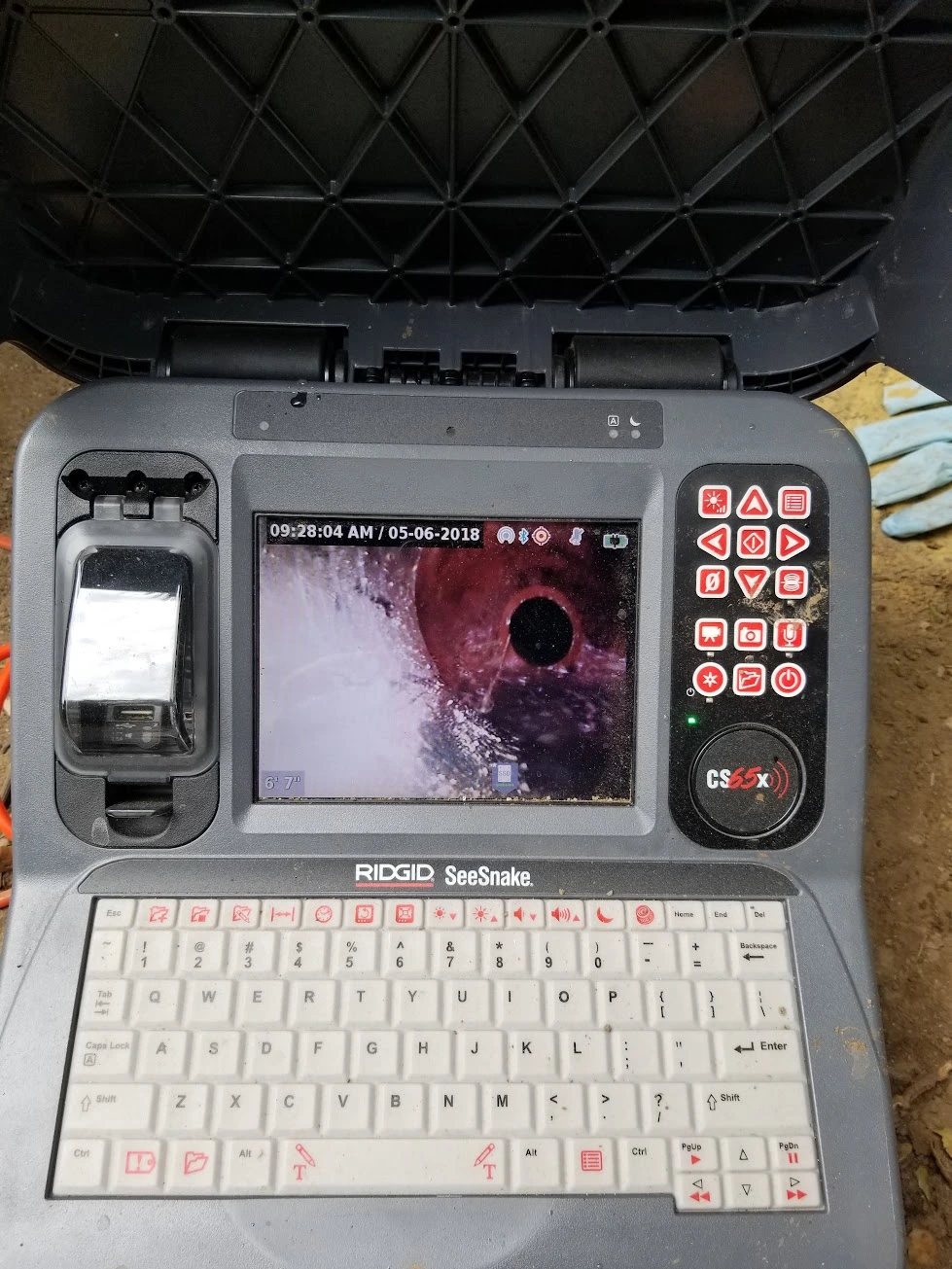
If you've never had one, the process is straightforward and a lot shorter than you'd expect. Here's what a typical visit looks like end to end.
1. About an hour on site
From the time we arrive, set up, and pack out, plan on roughly an hour. Easy lots with a clear cleanout run shorter; complex lots with hard-to-find access can run longer.
2. Camera goes from cleanout to street
We feed an HD camera head on a flexible push rod from the main cleanout out toward the municipal main. We log the full run, both directions of any branches, and pause at every defect to record depth and distance.
3. You watch live on the monitor
You can stand next to me at the truck while we run the line. I narrate what we're looking at — this is a joint, this is a root mass, this is a clear pipe — in plain English. By the time we pack up, you've already seen the line yourself.
4. Video file + photo report delivered same-day
You get an HD video file you keep forever (helpful for resale, escrow, or future plumbers), plus a written report with timestamps, distance markers, and a clear summary of findings. Same-day delivery is the norm.
That's it. No upsell at the end of the visit, no follow-up sales call.
If the line is healthy, you leave with a baseline video. If it's failing, you leave with documentation precise enough to get apples-to-apples bids from three different repair plumbers — which is where the real money is saved.
How to choose an inspector (red flags)
Not every "sewer scope" is the same product. A few patterns to watch for — and a parallel list of what a clean offer looks like.
Red flags
- "Free inspection" with a repair contractor. It's a sales call, not an inspection. The technician is paid on close, not on diagnostic accuracy.
- $99 sewer scope. Read the fine print. Locating fee, video link fee, written-report fee, and "long lateral" surcharge usually add up to $400+ by the time the truck leaves.
- No flat published price. If the price depends on what they find, you're being underwritten by a quote algorithm, not paying for a service.
- Same company offers inspection AND repair. The conflict of interest is structural. The "diagnosis" is functionally the opening of a sales pitch.
What to look for
- Flat published price. You should know what you're paying before booking. We charge a flat $199 across all of Santa Barbara County.
- Neutral CPI or journeyman credentials. A Certified Professional Inspector or licensed journeyman plumber whose only product is the inspection.
- No repair upsell. A neutral inspector should refuse to bid repairs at all. Ask the question directly.
- HD video file you keep. Not a streamed link that expires — an actual file you own and can hand to a future plumber, buyer, or insurer.
Common questions
Ten of the most common homeowner questions on failing sewer laterals, answered.
Can a broken sewer line cause foundation problems?
Why do I smell sewage only after it rains?
Will a drain snake fix the problem?
How long can I wait before scoping a suspect line?
Can tree roots really break a sewer pipe?
What does a sewer scope cost in Santa Barbara?
Is a smell test reliable?
Can I scope my own line?
What if my line is shared with a neighbor?
Does homeowners insurance cover sewer repair?
See any of these signs? Scope before you snake again.
$199 flat across Santa Barbara County. HD video file you keep, written report with timestamps, same-day delivery, no repair upsell at the end of the visit.
This article is general information, not plumbing or engineering advice. Specific conditions vary by property, and an in-person scope is the only way to confirm a diagnosis. Coastal Shield Home Inspections does not perform repairs; we provide neutral diagnostic information so homeowners can shop repairs independently.